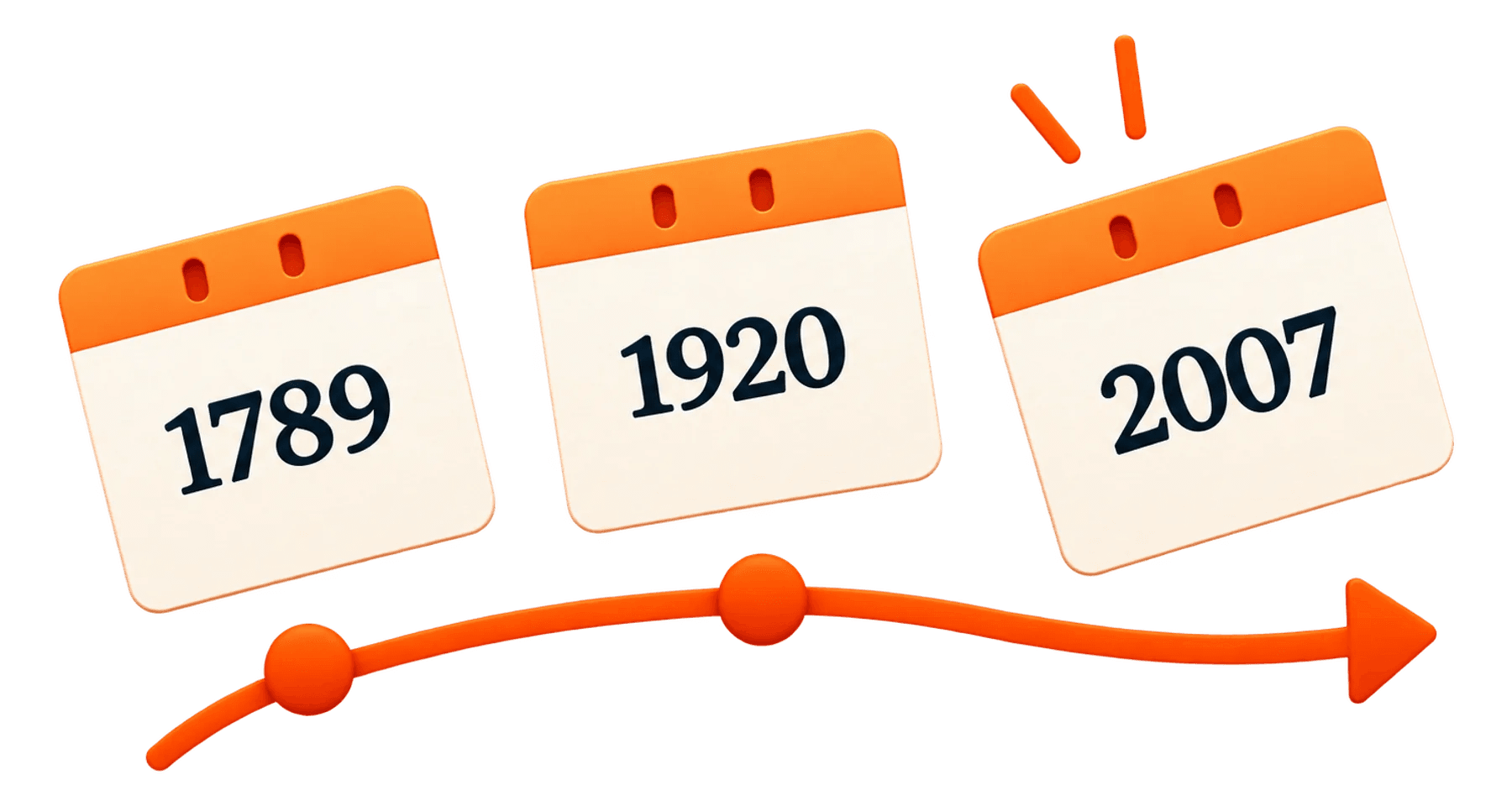
Why putting events in order is harder than naming the year
A timeline puzzle hands you a few events and asks which came first. It sounds like a test of dates, but most people who are good at it could not tell you many exact years. What they have is a sense of how events connect, and that turns out to matter more than a head full of numbers.
The reverse is also true. Knowing a date for every event is no help if two of the dates you know are wrong, and a single wrong date can put three events out of order at once.
Order is not the same knowledge as a date
You may not know the year of the first powered flight, but you know it came before the first Moon landing, because nobody could fly to the Moon before anybody could fly at all. That kind of knowledge is about dependency: one thing had to exist before the other could. It is often more reliable than a remembered year, because it comes from understanding rather than recall.
Dependency does not always point the way you expect, though. Alexander Bain patented a device for sending images over a telegraph wire in 1843, more than thirty years before Alexander Graham Bell’s telephone patent in 1876. A fax sounds like a later invention than a telephone because it is a more complicated idea to a modern reader, but it only needed the telegraph, and the telegraph came first.
Why history gets squashed
Periods we learn about as one chapter feel short, even when they are long. The Roman Empire is a good example. Julius Caesar was killed in 44 BC, and the last emperor in the west was deposed in AD 476. That is more than five hundred years, nearly as long as the time from Columbus’s first voyage in 1492 to today. Because both events belong to “ancient Rome” in most people’s minds, the gap between them disappears.
The same thing happens in the other direction, when events in different chapters happened at the same time. The eastern half of the Roman Empire lasted until Constantinople fell in 1453, which is the same decade Johannes Gutenberg was printing with movable type in Mainz. One event is usually filed under the ancient world and the other under the start of the modern one, but they were news in the same years.
Close events are the real test
Two events a thousand years apart are easy to order even if you misjudge both of them by a century. Two events in the same decade are where the puzzle is. For those, a rough date is not enough, and you need a reason one of them came first.
A few questions help. Did one event cause the other, or make it possible? Did the same person take part in both, and if so, at what stage of their life? Was one of them the first of its kind, so that the other could only have come after? These questions give you an order even when you have no year for either event.
How to work through a puzzle
Start with the event you are surest of, and use it as an anchor. If a puzzle gives you one date, that is your anchor, and every other event is either before or after it. Place the events that are far from the anchor first, because those are the ones you are least likely to get wrong, and leave the close pairs until last.
When you are torn between two positions, ask what you actually know about each event rather than how old it feels. A feeling of “this seems older” is usually the squashing effect at work, and it is wrong often enough that it should not decide a close call.
Finally, when an answer comes back wrong, look at which events moved. A wrong position usually means one belief is off, and correcting that belief often fixes several events at once.